Nicoll Highway: When Temporary Support Failed
TWInst Editorial Team · 4 min
On 20 April 2004, part of Singapore's Nicoll Highway collapsed into a deep excavation for the Circle Line MRT project. Four workers lost their lives. The excavation was approximately 33 metres deep and supported by diaphragm walls, steel walers, cross-lot struts and jet-grout slabs.
How the system was intended to work
The diaphragm walls retained the surrounding soil and groundwater. Loads acting on those walls were transferred through the walers into the steel struts spanning the excavation. This created a continuous load path:
Ground → diaphragm wall → waler → connection → strut → opposite wall
Every component, and every connection, was essential to the stability of the excavation.
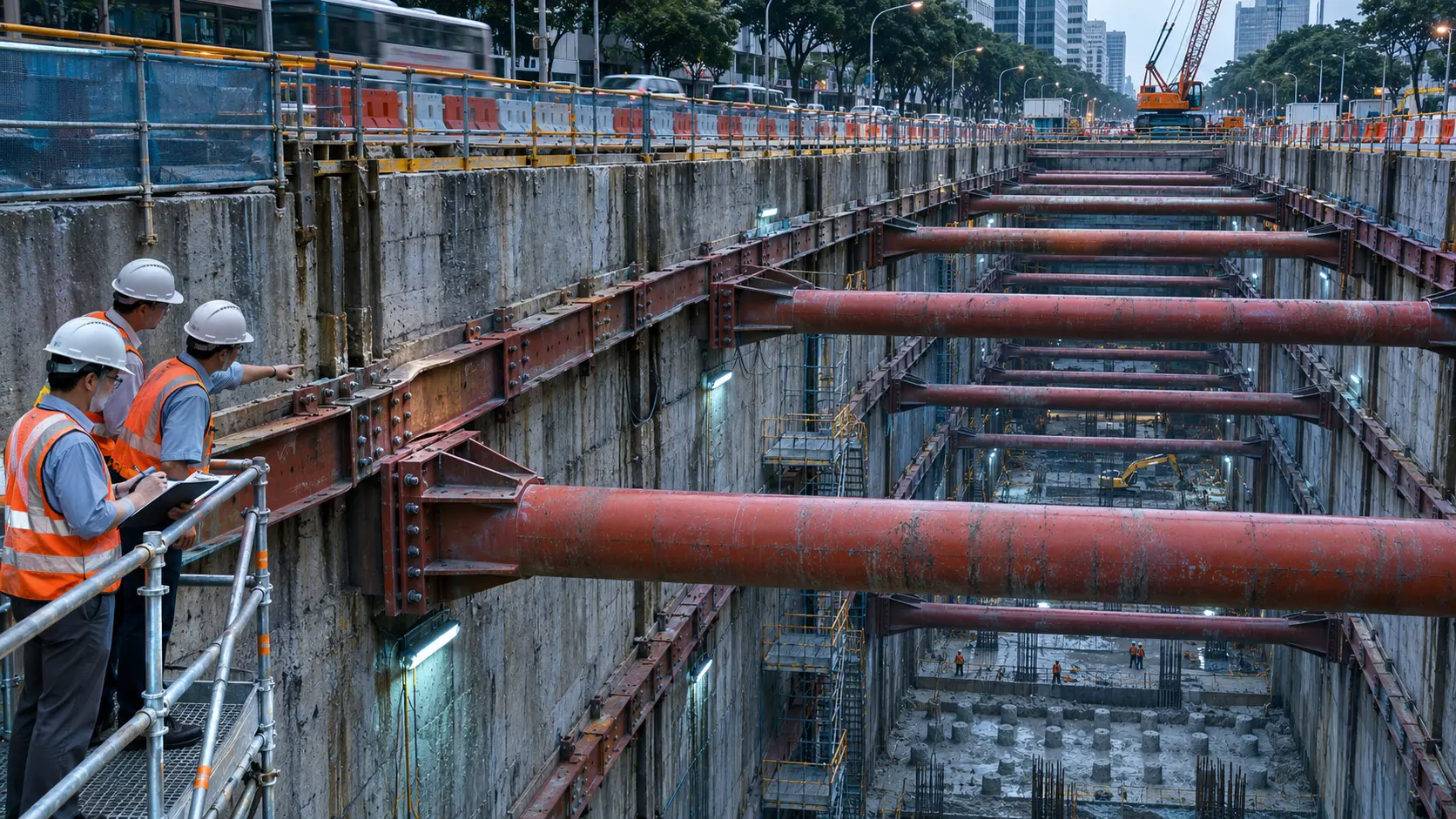
What happened
The official Committee of Inquiry concluded that the collapse was initiated by failure of the strut–waler support system. Several walers buckled, after which the retaining walls moved inward and the surrounding ground collapsed into the excavation.
The investigation identified three interacting problems:
- The soil model used in the analysis overestimated soil strength and underestimated forces on the retaining walls.
- Important strut-to-waler connections were under-designed.
- Construction deviations further weakened the installed system.
The combined effect reportedly left the strut–waler system approximately 50% weaker than required.
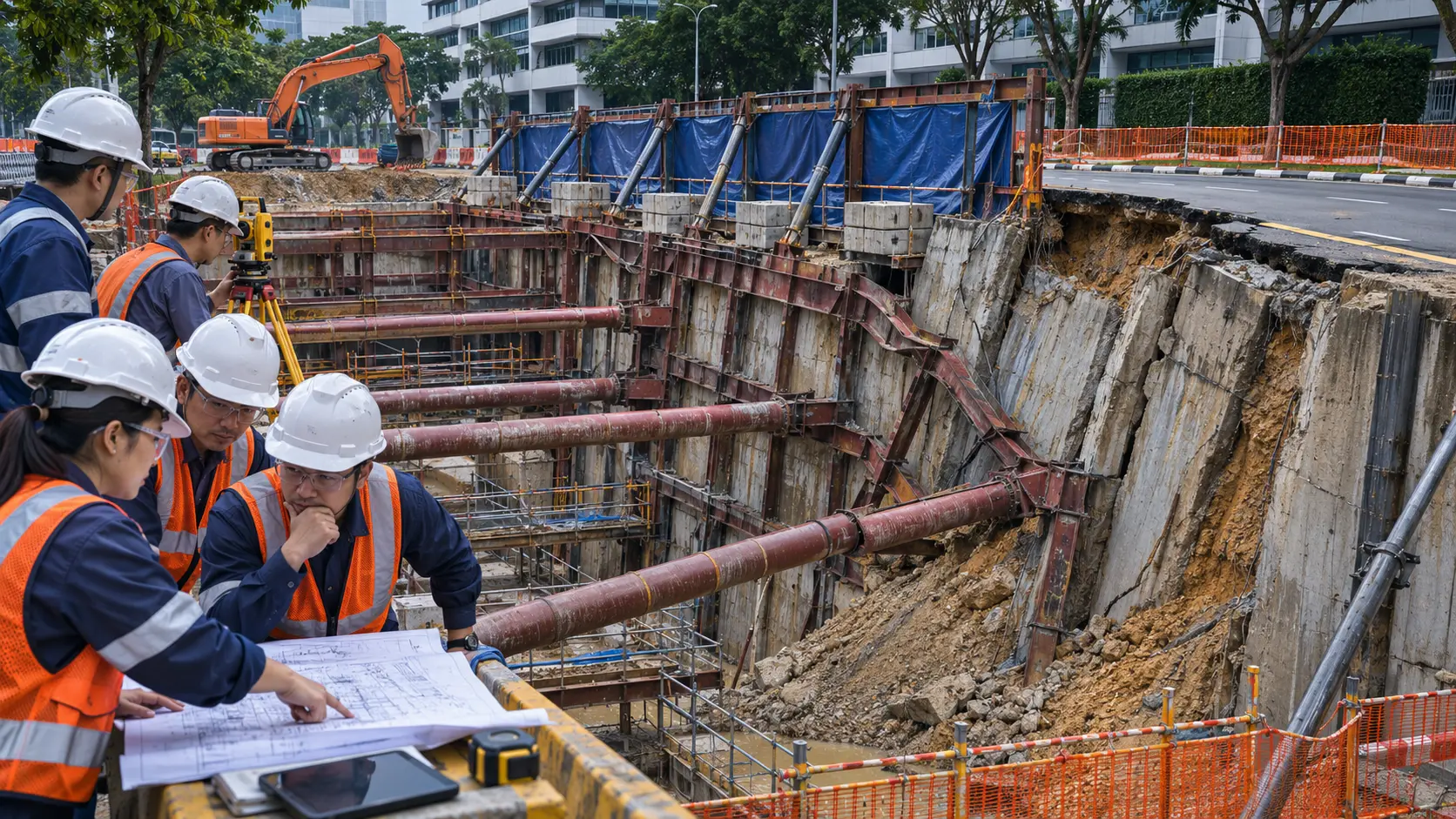
The temporary-works lesson
Nicoll Highway demonstrates that a temporary-works design cannot be controlled through calculations alone. The analytical model, connection design, installation and actual ground behaviour must remain consistent.
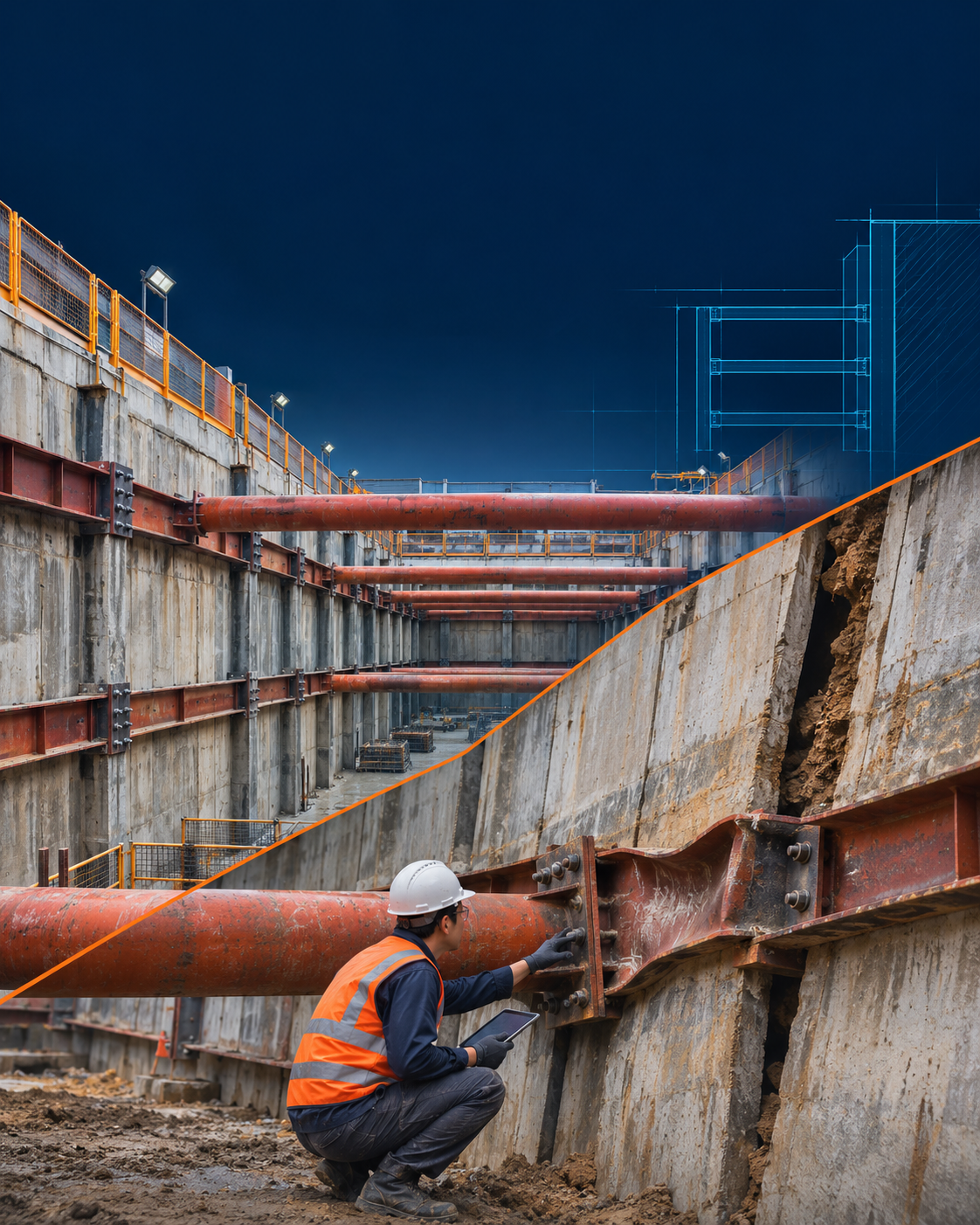
For deep excavations, effective control should include:
- Independent checking of soil assumptions and structural load paths
- Detailed verification of walers, stiffeners and connections
- Inspection of the installed system against approved drawings
- Monitoring with clearly defined review and stop-work thresholds
- Formal management of deviations and design changes
- Rapid escalation when measured movement exceeds predictions
A deep excavation is only as reliable as its model, connections and installation working together.
This article is provided for general education and does not replace project-specific design, approved procedures or professional review. The accompanying images are AI-generated educational reconstructions, not historical photographs.