Excavation Support: Holding the Ground While Construction Moves Forward
TWInst Editorial Team · 4 min
Excavation support is used to retain soil, protect workers and control ground movement while construction takes place below the surrounding ground level.
These systems may support deep basements, utility trenches, shafts, tunnels, bridge foundations and other infrastructure works. Although they are temporary, they can carry significant soil, water, surcharge and construction loads.
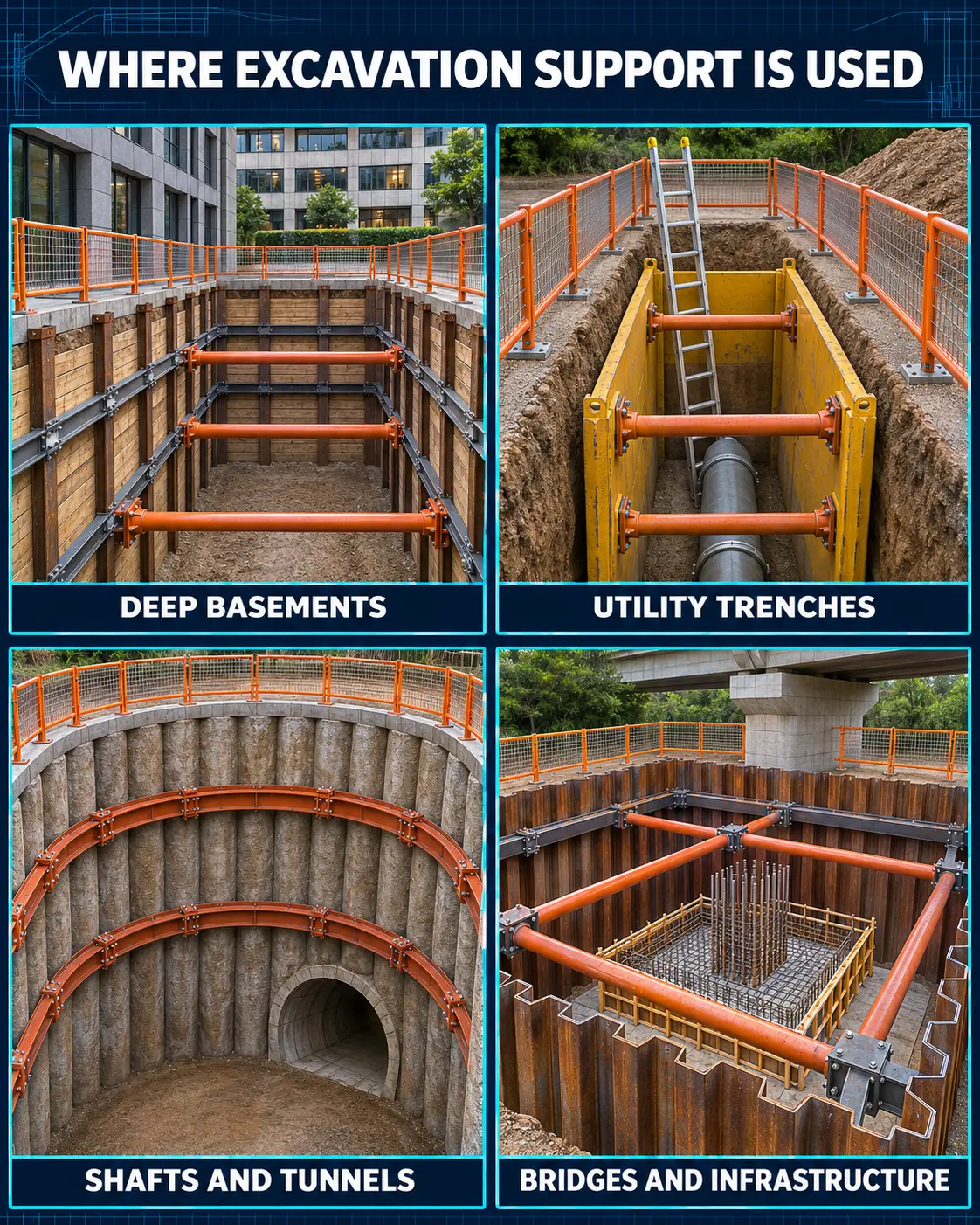
Common applications and systems
The selected system depends on the excavation geometry, soil and groundwater conditions, surrounding structures, underground services, available working space and construction sequence.
Common arrangements include:
- Soldier piles with timber or precast lagging
- Sheet-pile walls
- Secant or contiguous pile walls
- Internal walers and cross-lot struts
- Ground anchors or tiebacks
- Hydraulic or timber trench shoring
- Trench shields or trench boxes
- Sloped or benched excavations where permitted
A trench shield primarily protects workers within its protected zone. It should not automatically be treated as a system that prevents ground movement unless it is specifically designed and installed for that purpose.
Main components
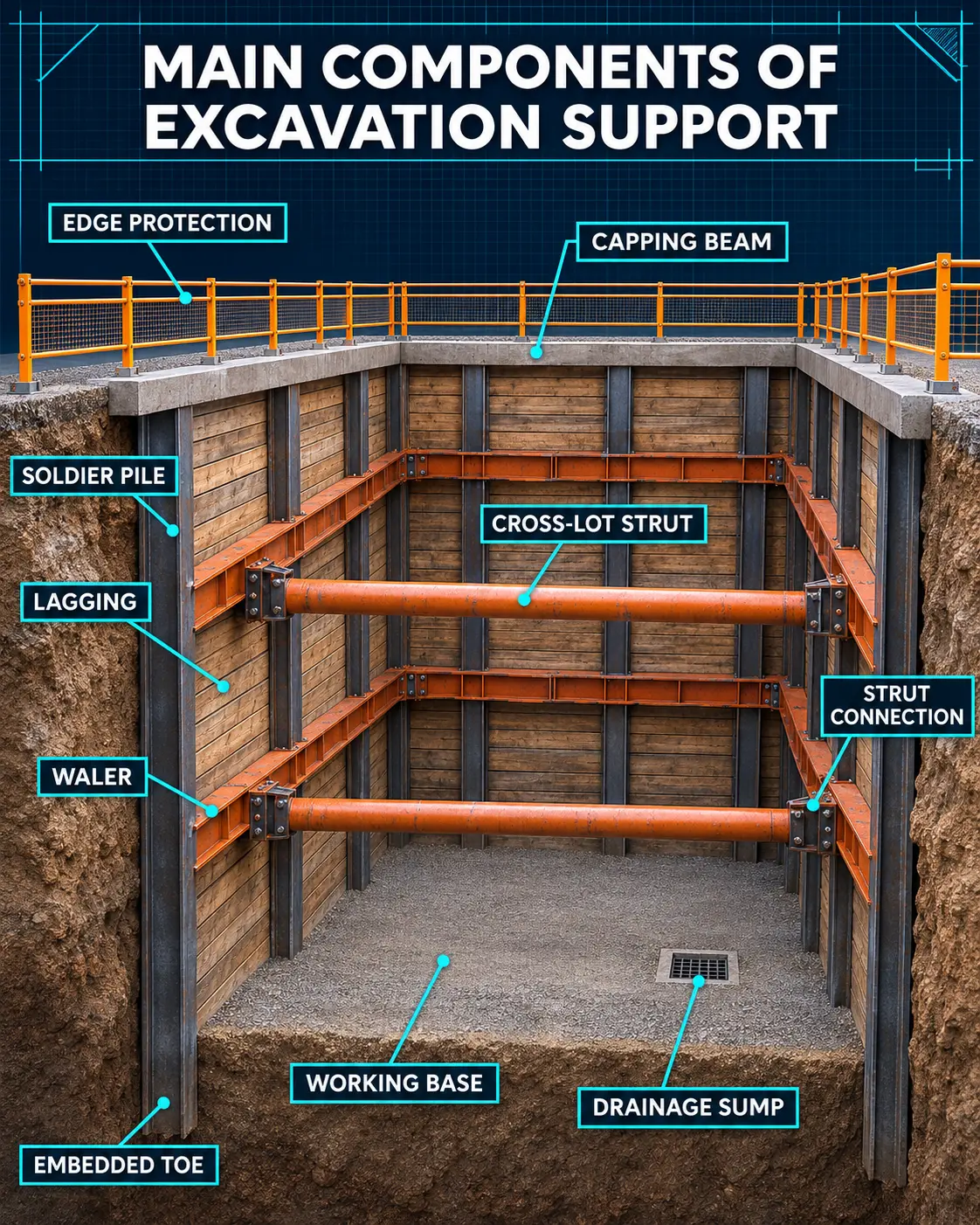
A typical internally braced excavation may include retaining-wall elements, capping beams, walers, struts, connections and embedded wall toes.
The walers collect loads from the retaining wall and transfer them into the struts. Strut connections, bearing details and supporting foundations are therefore essential parts of the load path.
Working bases, drainage systems, access arrangements and edge protection must also be considered as part of the overall excavation environment.
How the system carries loads
Excavation support is mainly affected by:
- Lateral soil pressure
- Groundwater pressure
- Surcharge from equipment, materials and nearby structures
- Construction and traffic loads
- Forces created by the excavation and support sequence
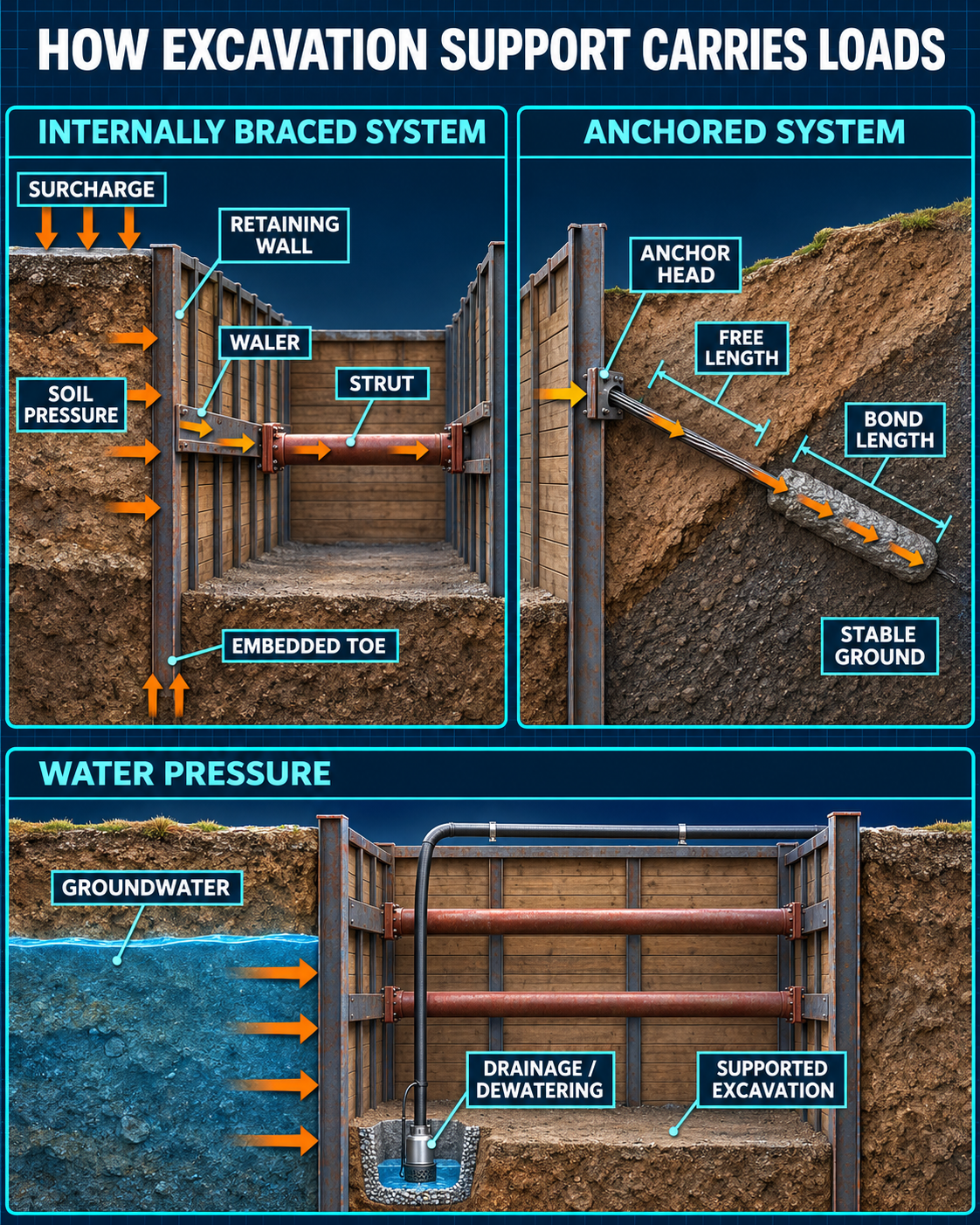
In an internally braced system, pressure acts on the retaining wall and transfers through the walers into the struts. The struts generally work in compression and transfer loads to the opposite side of the excavation.
In an anchored system, loads pass from the wall through the anchor head and tendon before being transferred through the bonded length into suitable ground.
The embedded portion of the wall may also contribute resistance below the excavation level. Groundwater must be included because uncontrolled water can increase pressure, weaken the ground and affect the stability of the excavation or surrounding area.
Planning and management
Excavation support should be considered from the beginning of the temporary-works planning process. The project team should establish:
- Excavation limits, depth and construction stages
- Available geotechnical and groundwater information
- Underground services and adjacent structures
- Expected surcharge and equipment locations
- Required support-system design and review
- Installation, inspection and removal sequences
- Access, edge protection and emergency arrangements
- Monitoring requirements and acceptable movement limits
- Responsibilities, hold points and change-control requirements
Support should generally be installed as excavation progresses. Excavation should not continue below a planned support stage until the required support has been installed and released for use.
The system should be inspected at the required frequency and following events that could affect it, such as heavy rainfall, groundwater changes, impact, unexpected movement or changes to nearby loading.
Ontario’s Construction Projects Regulation generally requires excavation walls to be supported unless a stated exception applies. It also requires prefabricated, hydraulic and engineered support systems to be designed by an engineer and installed, used and maintained according to their design documentation.
Ontario guidance also addresses locating services, protecting adjacent structures, controlling water and keeping equipment and excavated materials away from excavation edges. Requirements vary across Canada, so the applicable provincial or territorial legislation must always be confirmed.
Basic Do’s and Don’ts
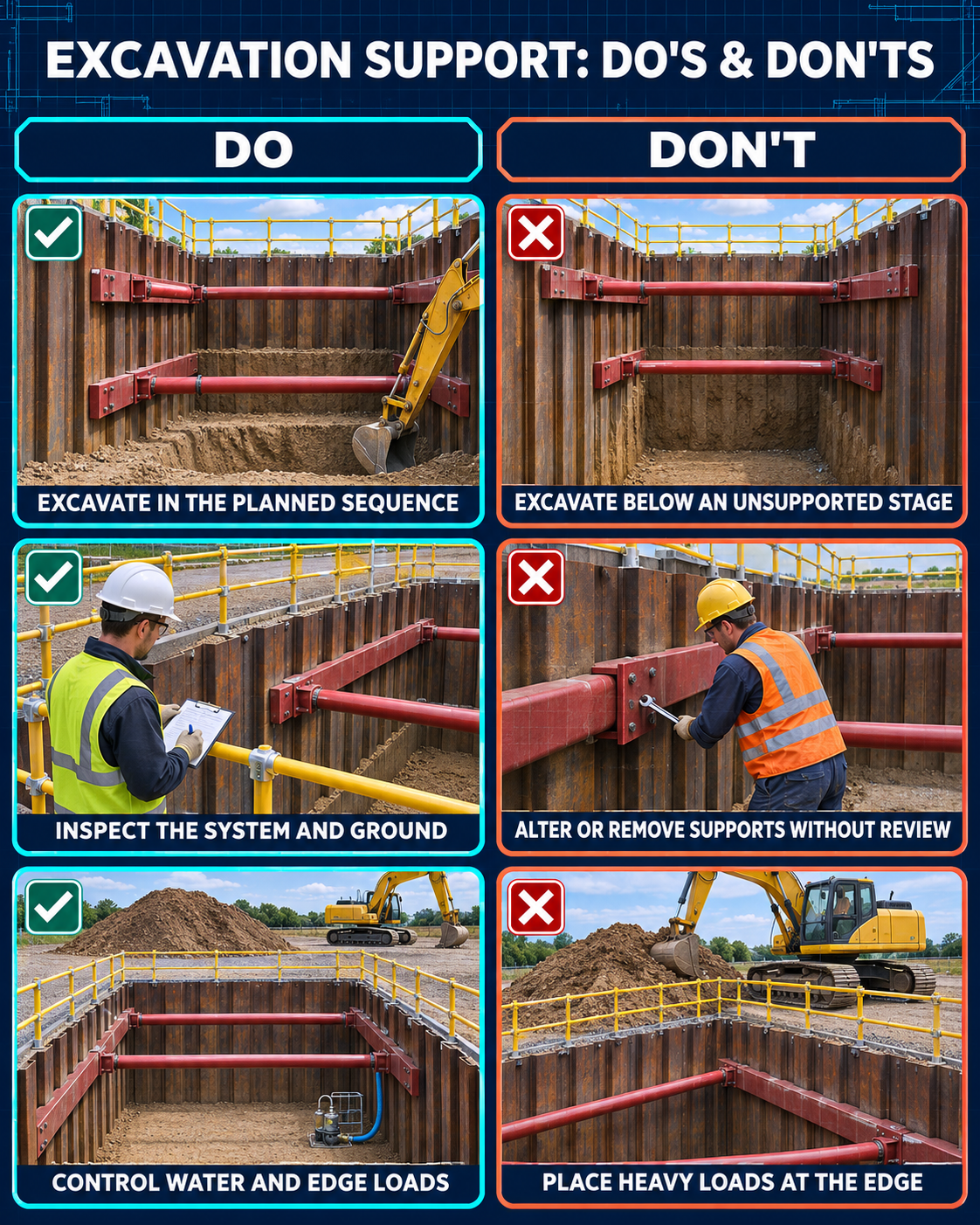
Excavate in the planned sequence, inspect the system and surrounding ground, and control water and edge loading.
Do not excavate below an unsupported stage, alter structural components without review or place heavy equipment and stockpiles beside the excavation edge.
Removal is also a planned temporary-works stage. Struts, anchors, walers or other supports should not be removed until the approved sequence confirms that the remaining system and permanent works can safely carry the resulting loads.
Final takeaway
Excavation support is not simply a wall placed against the ground. It is a complete system in which the retaining elements, walers, struts or anchors, embedded toe, groundwater controls and construction sequence work together.
Its safety depends on maintaining a continuous load path and following the planned sequence from installation through final removal.
This article provides general educational information. Project-specific work should follow applicable legislation, approved engineering documents, geotechnical recommendations and the project’s temporary-works procedures.